Introduction
As businesses grow, their inventory systems often shift from being helpful tools to critical bottlenecks. What once worked seamlessly for a small warehouse can quickly become inefficient under increased demand. The result? Delays in order fulfillment, inaccurate stock levels, frustrated customers, and ultimately, lost revenue.
Scaling a business successfully requires more than just increasing sales—it demands systems that can grow alongside operations. Inventory management sits at the heart of this challenge.
The Core Problem
Many traditional inventory systems are built using centralized, tightly coupled architectures. While this approach may be sufficient in the early stages, it becomes increasingly fragile as complexity grows.
Common issues include:
- Slow performance under heavy load: As transaction volumes increase, centralized systems struggle to keep up.
- Data inconsistencies: Multiple services interacting with the same system can create conflicting records.
- Integration challenges: Connecting with external platforms like e-commerce marketplaces or logistics providers becomes difficult and error-prone.
These limitations not only affect internal efficiency but also directly impact customer experience.
Where Things Go Wrong
1. Poor Data Synchronization
Modern businesses often rely on multiple systems—such as point-of-sale (POS) systems, warehouse management tools, and online marketplaces—all interacting with inventory data. When these systems update stock levels independently without proper coordination, discrepancies are inevitable.
For example, an item sold on one platform may not be reflected immediately on another, leading to overselling or incorrect stock counts.
2. Lack of Real-Time Updates
Many legacy systems depend on batch processing, where updates are made at scheduled intervals rather than instantly. While this may reduce system load, it introduces delays that can be costly.
Without real-time updates:
- Customers may purchase items that are already out of stock
- Businesses may miss opportunities to sell available inventory
- Decision-making becomes based on outdated data
3. Monolithic Architecture
In a monolithic system, all components are tightly integrated into a single codebase. While simpler to build initially, this design becomes a liability at scale.
A single failure—whether in order processing or stock updates—can disrupt the entire system. Additionally, scaling specific parts of the system independently becomes nearly impossible, limiting flexibility and resilience.
The Modern Solution: Event-Driven Architecture
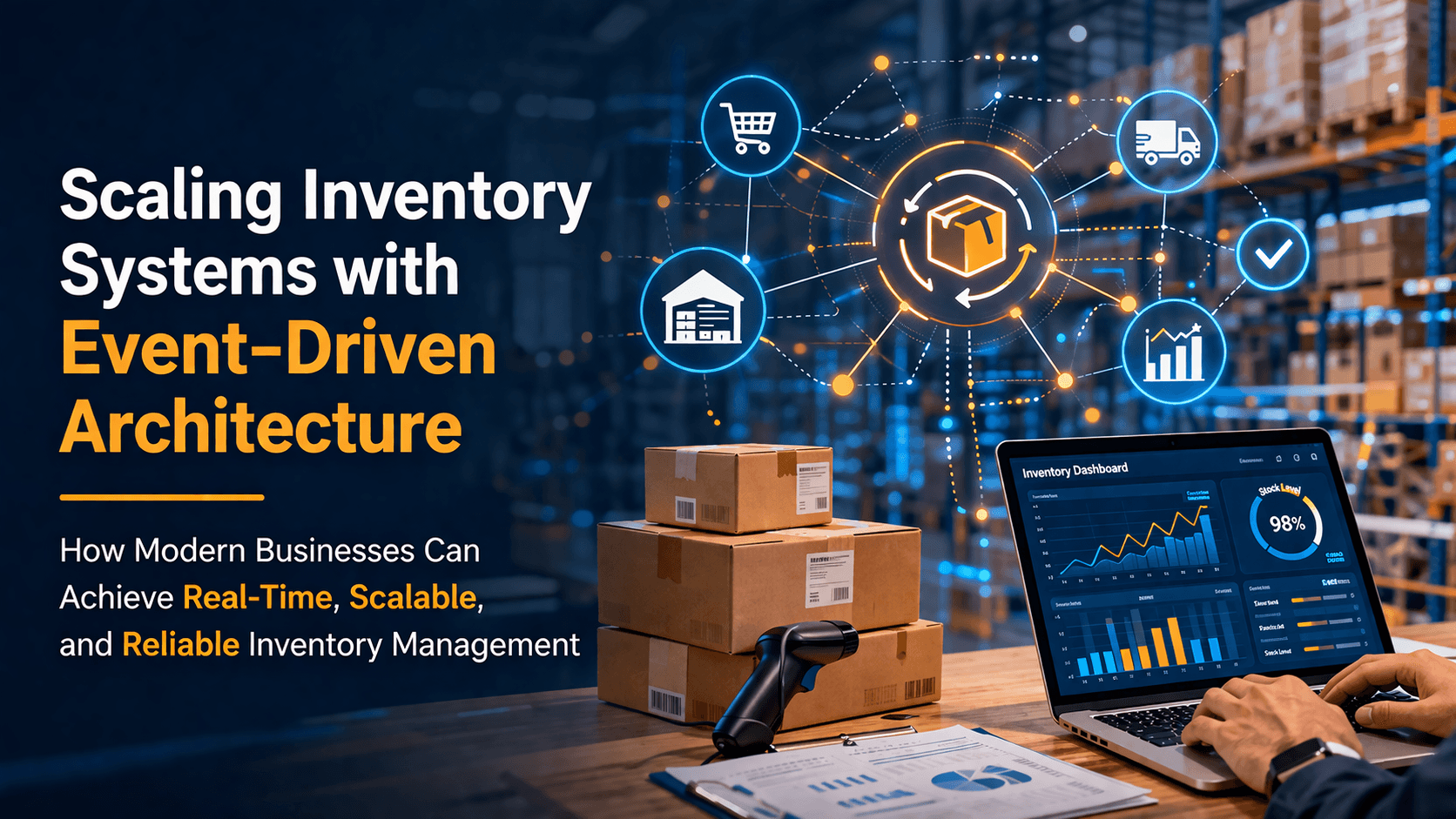
To overcome these challenges, many organizations are adopting event-driven architecture (EDA)—a modern approach that enables systems to communicate through real-time events rather than direct dependencies.
How It Works
In an event-driven system:
- Every change in inventory (e.g., stock added, item sold, order canceled) generates an event
- These events are published to a central event bus
- Other services subscribe to relevant events and react accordingly
This allows systems to remain loosely coupled while staying synchronized in real time.
Key Benefits
- Decoupled Services: Each service operates independently, reducing the risk of cascading failures
- Real-Time Synchronization: Updates propagate instantly across all systems
- Scalability: Services can scale individually based on demand
- Resilience: Failures in one component do not bring down the entire system
Implementation Strategy
Transitioning to an event-driven architecture requires careful planning. Here’s a practical approach:
Step 1: Introduce an Event Bus
Start by implementing an event streaming platform such as Apache Kafka or RabbitMQ. This serves as the backbone for communication between services, ensuring reliable event delivery.
Step 2: Break Down Services
Gradually decompose your monolithic system into smaller, focused services. For example:
- Stock Service: Manages inventory levels
- Order Service: Handles customer orders
- Notification Service: Sends alerts and updates
This modular approach improves maintainability and scalability.
Step 3: Ensure Idempotency
In distributed systems, duplicate events are inevitable. Designing services to handle repeated events safely—without causing inconsistencies—is critical.
Idempotent systems ensure that processing the same event multiple times produces the same result, preserving data integrity.
Real-World Impact
Organizations that successfully adopt event-driven architectures often see significant improvements, including:
- Up to 70% faster inventory updates
- Reduced system downtime due to improved fault isolation
- Seamless integration with third-party platforms and services
- Greater agility in responding to market demands
These benefits translate directly into better customer experiences and stronger competitive positioning.
Conclusion
Scaling inventory systems is not just about handling larger volumes of data—it’s about rethinking how systems are designed and how they communicate.
By moving away from rigid, monolithic architectures and embracing event-driven principles, businesses can transform inventory management from a persistent challenge into a strategic advantage.
In a fast-paced, interconnected world, the ability to maintain accurate, real-time inventory is no longer optional—it’s essential.